
A laboratory-made crown usually takes at least two visits, with a temporary crown in between.
A dental crown made in a laboratory usually takes at least two visits. At the first, the dentist examines the tooth, shapes it, records it with an impression or a digital scan and, where the plan calls for it, fits a temporary crown. At the second, after the laboratory has made the crown, the dentist checks the fit and the bite and then fixes it in place. Extra visits come in when something has to be treated first, most often a root canal, or when several teeth are being crowned at once. How many days that adds up to in Korea depends on the tooth, the material and the laboratory schedule, and it is confirmed after the examination.
This article goes through the crown itself: what happens at each visit, how to look after a temporary crown, when a root canal changes the order, what the fitting visit involves, how a return flight fits around a temporary or a new crown, and how the material is chosen. If you are still deciding whether a tooth needs a crown or a veneer, our article on how the choice between crowns and veneers is made covers that first.
What happens at each visit
A crown covers the whole visible part of a tooth. The US National Library of Medicine's MedlinePlus describes the usual route as two dental visits: the tooth is prepared, an impression is taken for the laboratory and a temporary crown goes on, then the permanent crown is fitted and cemented at the second visit. Australia's public health service, healthdirect, describes the same steps and notes that the record of the tooth can be an impression or a digital scan.
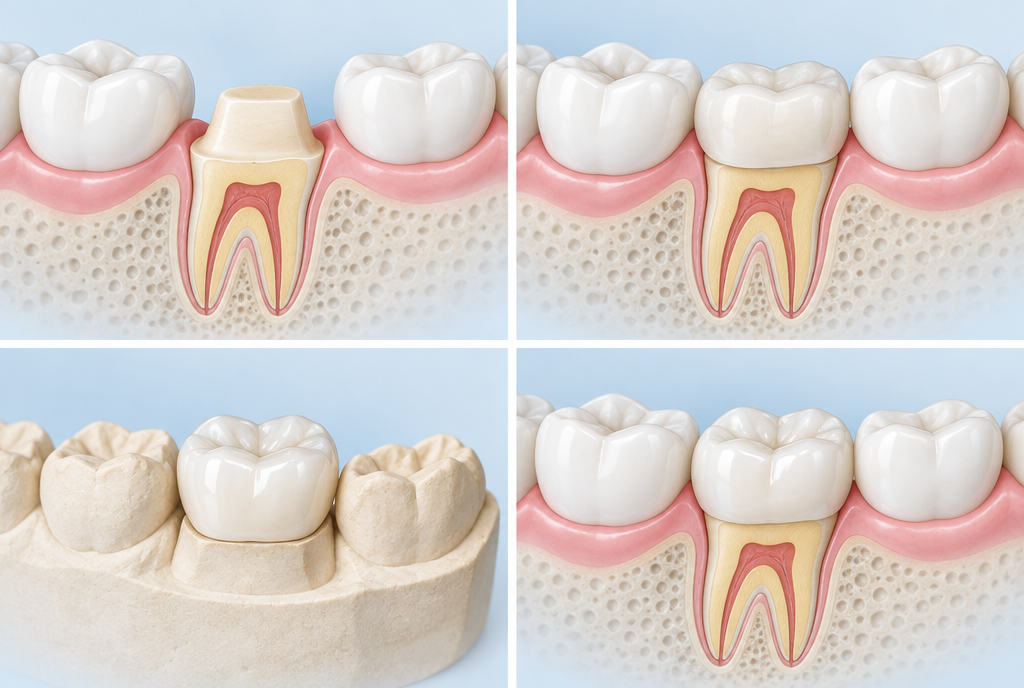
At Today Dental Clinic the restorative work follows the same pattern. The clinic's published information describes an impression or scan taken at the preparation visit, a temporary fitted where the plan calls for it, and the restoration made in a dental laboratory between visits. The clinic's Korean website says it works with five partner dental laboratories.
| Stage | What happens | What it means for your trip |
|---|---|---|
| Examination | The tooth is checked clinically and on X-ray. Old fillings, cracks, the nerve and the bite are assessed, and the crown material is discussed | Book it at the start of the trip, because the plan can change here |
| Treatment first, if needed | A root canal, decay under an old filling or a gum problem is dealt with before the crown | Adds visits, and sometimes days between them |
| Preparation | The tooth is shaped so the crown has room. An impression or scan is taken and the shade is recorded. A temporary crown goes on | Often the same day as the examination, unless something had to come first |
| Laboratory | The crown is made to the recorded shape, bite and shade | The schedule is set when the plan is made |
| Fitting | The temporary comes off, the crown is tried in, the bite is checked and adjusted, and the crown is fixed in place | Leave a little time after this visit before flying |
Some dentists scan a tooth and make the crown in their own office in a single visit. MedlinePlus and healthdirect both mention this. Today Dental's published information describes laboratory-made restorations, so this article follows that route. If a one-visit option matters for your schedule, ask about it at the consultation rather than assuming it.
Whether the impression is a tray of material or a digital scan, it records the prepared tooth, the teeth around it and the teeth it bites against, so the laboratory can make a crown that fits the space and the bite. The method is chosen by the dentist. It does not change the basic sequence.
Living with a temporary crown
A temporary crown covers the prepared tooth while the laboratory works. It protects the tooth, keeps it from shifting and lets you eat and smile normally in the meantime. It is held on with cement that is meant to come off easily at the next visit, which is also why it can loosen.

MedlinePlus gives three practical rules for a temporary crown:
- Slide dental floss out sideways instead of lifting it up, because lifting can pull the crown off.
- Avoid sticky foods such as caramels, gummy sweets and chewing gum.
- Chew on the other side of your mouth where you can.
Hard food is worth avoiding on that side too. Brush the area gently as usual, since the gum around a temporary still needs cleaning.
If a temporary crown comes off, keep it, and contact the clinic the same day with a photo if you can. A prepared tooth left uncovered can become sensitive and the teeth around it can move slightly, which may affect how the final crown fits. If you are still in Korea, the dentist can check the tooth and refit or remake the temporary.
A temporary crown is not meant to last. If you are planning to fly home with one and come back later for the final crown, that changes the advice, and it is covered in the flight section below.
When a root canal or other treatment comes first
Many crowns are planned because of what has already happened to the tooth: a large old filling, a crack, decay, or a nerve that has become inflamed. Sometimes the examination shows that the tooth needs root canal treatment before it can be crowned. Today Dental Clinic's root canal page describes the order: the canals are cleaned and sealed, and the weakened tooth is then protected with an appropriate restoration or crown, chosen according to how much of the tooth remains.
The American Association of Endodontists advises that a tooth should be restored as soon as possible after root canal treatment, that temporary restorations do not keep out contamination for long, and that back teeth with root canal treatment should receive a restoration that covers the cusps. healthdirect adds that delaying the final crown or filling after a root canal raises the risk that the tooth breaks or has to be removed. If a lot of the tooth is missing, the dentist may rebuild a core inside it first. The AAE notes that a post is used only when it is needed to hold that core.
A tooth that already has an old crown can hold surprises of its own. Today Dental's dentists have described removing old crowns and finding decay or a darkened tooth underneath. Decay has to be cleaned out, and a dark tooth can show through a new ceramic crown, so the plan may add a step before the final shade is chosen.
For a traveller, the effect is on the calendar. A root canal can take more than one appointment, and the crown preparation follows once the tooth is ready. Our article on root canal treatment during a Korea trip explains how those appointments are spaced.
The fitting visit and bite adjustment
At the second visit the temporary is removed and the tooth is cleaned. The new crown is tried in before anything is fixed. The dentist checks how it seats at the gum line, how it touches the neighbouring teeth, the shade, and how your teeth meet when you bite and slide your jaw. healthdirect describes this check of fit and bite before the crown is cemented or bonded.
Small adjustments to the biting surface are normal at this stage. It may take a few days to get used to a new crown. MedlinePlus advises contacting your dentist if the bite does not feel right or the tooth feels out of place, and notes that a tooth that still has its nerve may feel sensitive to heat or cold for a while. Leaving a day or two after the fitting gives room for a second bite check if you need one.
Before you leave, ask for a written note of what was done on each tooth, the material used and the X-rays taken. A dentist at home will need that information for routine check-ups.
Flying home with a temporary crown or a new crown
There are two common situations. In the first, all visits fit into one trip and you fly after the final crown is fitted. In the second, the treatment is split: you fly home with a temporary, or with a root-treated tooth and a temporary restoration, and return for the final crown later.

Pressure in an aircraft cabin is lower than on the ground. Reviews of tooth pain at altitude, known as barodontalgia, link it mainly to teeth that already have a problem, such as an inflamed nerve, decay or a faulty restoration. A healthy tooth with a well-fitted crown is not the usual concern. The more practical risks for a traveller are a temporary crown coming loose away from the clinic, and a bite that needs adjusting after you have already left.
A 2023 paper on dental travel in the British Dental Journal offered starting points for the gap between treatment and flying: at least 24 hours after restorative treatment and at least 72 hours after root canal treatment done without surgery, with one week suggested after most dental treatment. The authors note that research on commercial flights is limited and that the interval should be set for each patient. Your dentist will tell you what applies to your tooth.
| Situation | What to keep in mind | What to ask the clinic |
|---|---|---|
| Final crown fitted, flying soon after | Bite adjustments are easier while you are still nearby | Is there a minimum gap before my flight, and when is a bite check useful? |
| Flying home with a temporary crown | Temporary cement is designed to come off. It is not a long-term restoration | How long can this temporary stay on, and when should I come back? |
| Root canal done, crown on a later trip | A root-treated tooth left without its final restoration is at greater risk of breaking | What restoration goes on before I fly, and what should I avoid biting? |
| Temporary comes off while travelling | The tooth can become sensitive and the teeth around it can shift | Who do I contact, and can a dentist at home recement it? |
If the treatment is split across trips, fix the date of the return visit before you leave instead of leaving it open. Our article on when you can fly after dental treatment covers flight timing for other treatments, such as extractions and implants.
Zirconia or another material: decided at the examination
Crowns can be made of metal, porcelain fused to metal, or all-ceramic materials such as zirconia and glass-ceramics. MedlinePlus and healthdirect list these options. Each has trade-offs. Metal holds up well but does not look like a tooth. Ceramics match tooth colour but behave differently under biting force.
Today Dental's dentists have explained the difference between the ceramics this way: zirconia is strong but lets less light through, so it can look slightly more opaque, while glass-ceramic is more translucent but not as strong. That is why a front tooth and a back molar in the same mouth may end up with different materials. A systematic review of single crowns (Sailer and colleagues, 2015) reached a related conclusion: weaker silica-based ceramics should be limited to front teeth.
What the dentist looks at before recommending a material:
- Where the tooth is. Back teeth take more biting force. Front teeth are judged more on how they look in your smile.
- Your bite and habits. Heavy contact, clenching or grinding change what will hold up on that tooth.
- Room for the crown. Some materials need more thickness than others, which affects how much of the tooth is shaped.
- The colour of the tooth underneath. A darkened tooth may show through a translucent crown.
- The teeth next to it. A crown does not change colour after it is made. Today Dental's veneer page notes that existing crowns do not whiten the way natural teeth do, so if whitening is planned, it is usually done before the crown shade is chosen.
Asking for a material by name before the examination rarely saves time. Tell the dentist what matters to you, such as appearance, durability or a metal allergy, and let the choice follow from the tooth.
Before you book: what to send and what to ask
Useful things to send before you travel:
- Clear photos of the tooth from the front and from the biting side, in daylight.
- Recent X-rays from your home dentist, especially if the tooth has a large filling, an old crown or past root canal treatment.
- A short note on symptoms: pain when biting, sensitivity to hot or cold, or a crown that has come loose.
- Your travel dates, and whether a second trip is possible.
Questions worth asking at the consultation:
- Does this tooth need anything before the crown, such as a root canal or treatment of decay under an old filling?
- How many visits do you expect, and how many days between preparation and fitting?
- Will I have a temporary crown, and what should I avoid while wearing it?
- Which material do you suggest for this tooth, and why?
- How soon after the fitting can I fly?
To start, send your photos and travel dates through our photo consultation. A dentist will tell you what can be judged from the photos, what cannot, and how the visits would likely be arranged. Whether a crown is the right treatment, the material and the number of days are confirmed after the examination in the clinic. Our article on how many days to stay in Korea for dental work puts crowns alongside other treatments if you are planning more than one.
Today Dental Clinic (오늘의치과) has three locations: Gangnam Station and Cheongdam in Seoul, and Bucheon. Restorative plans are made by a team that includes board-certified specialists, and a plan that involves root canal treatment, gums and restorations is discussed by the specialists in each field. Specialists rotate between the branches, so the branch for your visit is confirmed when the appointment is arranged. This article was written from Today Dental Clinic's published information and the dentists' explanations. It is general information about dental crowns, not a diagnosis or a recommendation for any individual.
Questions Patients Ask
How many visits does a dental crown take in Korea?→
A laboratory-made crown usually takes at least two visits: one to examine and prepare the tooth, take an impression or scan and fit a temporary crown, and one to try in, adjust and fix the final crown after the laboratory has made it. More visits are needed if a root canal or other treatment has to come first, or if several teeth are being crowned. At Today Dental Clinic the number of days is confirmed after the examination.
Can a crown be done in one day?→
Some dentists scan a tooth and make the crown in their own office in a single visit. Today Dental Clinic's published information describes crowns and other restorations made in a dental laboratory between visits, so plan on at least two visits unless the dentist tells you otherwise after the examination. If a one-visit option matters for your schedule, ask about it at the consultation.
What should I avoid while wearing a temporary crown?→
Avoid sticky foods such as caramels, gummy sweets and chewing gum, and avoid hard food on that side. Chew on the other side where you can, and slide dental floss out sideways rather than lifting it, because lifting can pull the temporary off. If it comes off, keep it and contact the clinic the same day.
Can I fly home with a temporary crown and come back for the final crown?→
Some treatment plans are split across two trips, but a temporary crown is held with cement designed to come off and is not a long-term restoration. Ask the dentist how long your temporary can stay on, fix the date of the return visit before you leave, and ask who to contact if it loosens. If the tooth has had root canal treatment, delaying the final restoration raises the risk of the tooth breaking, so the timing matters more.
How soon can I fly after a crown is fitted?→
A 2023 paper in the British Dental Journal suggested at least 24 hours after restorative treatment and at least 72 hours after non-surgical root canal treatment as starting points, with one week suggested after most dental treatment, while noting that research on commercial flights is limited. The interval for your tooth is set by your dentist. Leaving a day or two after the fitting also gives room for a bite adjustment if you need one.
Is zirconia always used for crowns?→
No. Crowns can be made of metal, porcelain fused to metal, zirconia or glass-ceramic. Zirconia is strong but slightly more opaque, while glass-ceramic is more translucent but not as strong, so front and back teeth may be treated differently. The dentist recommends a material after looking at where the tooth is, your bite and habits, the room available and the colour of the tooth underneath.
Treatment results, cost and duration may vary by patient. Final treatment plan, cost and duration are confirmed after in-clinic diagnosis.