
A tooth that had a root canal can become painful or infected again, sometimes years later.
A tooth that has had a root canal can become painful or infected again, sometimes months or years after the first treatment. When that happens, there are usually three paths to discuss: redoing the root canal (retreatment), a small surgery at the tip of the root, or removing the tooth and replacing it. Which one suits your tooth is decided after an in-person examination and X-rays, sometimes with a 3D CT scan. Photos alone cannot show it.
For someone travelling to Korea, the choice also shapes the calendar. Retreatment can need more than one appointment when an infection is persistent, and the tooth usually needs a final protective restoration afterwards, which can mean another visit. This article explains why an old root canal can cause trouble again, what retreatment involves, how dentists weigh it against surgery or extraction, and how each path can fit around a trip. If you want to know how a first root canal usually runs, our guide to root canal treatment on a Korea trip covers that.
Why a treated tooth can cause trouble again
Root canal treatment removes inflamed or infected tissue from inside the tooth, cleans the canals and seals them. Usually the tissues around the root then settle. Sometimes they do not. The American Association of Endodontists (AAE) lists several reasons a tooth may not heal as expected after the first treatment:
- A narrow or curved canal was not reached and treated.
- The canal system had extra branches or unusual anatomy that went undetected.
- The crown or other final restoration was placed late.
- The restoration did not keep saliva, and the bacteria in it, out of the inside of the tooth.
A tooth that healed well can also meet a new problem later. New decay can reach the root filling. A crown or filling can loosen or crack and let bacteria back in. The tooth itself can fracture.
What people notice varies. A root-treated tooth may start to ache again, feel tender when you bite, or show swelling or a small boil on the gum beside it. Some problems give few signs. The AAE notes that cracks starting in the root often cause minimal symptoms and are sometimes found only when the surrounding bone and gum become infected. That is one reason the decision rests on X-rays and an examination, not on symptoms alone.
What retreatment involves
Retreatment repeats the cleaning and sealing of the canals, but it starts from a tooth that already has filling material inside and often a crown on top. At Today Dental Clinic it runs in phases, not a fixed number of appointments:
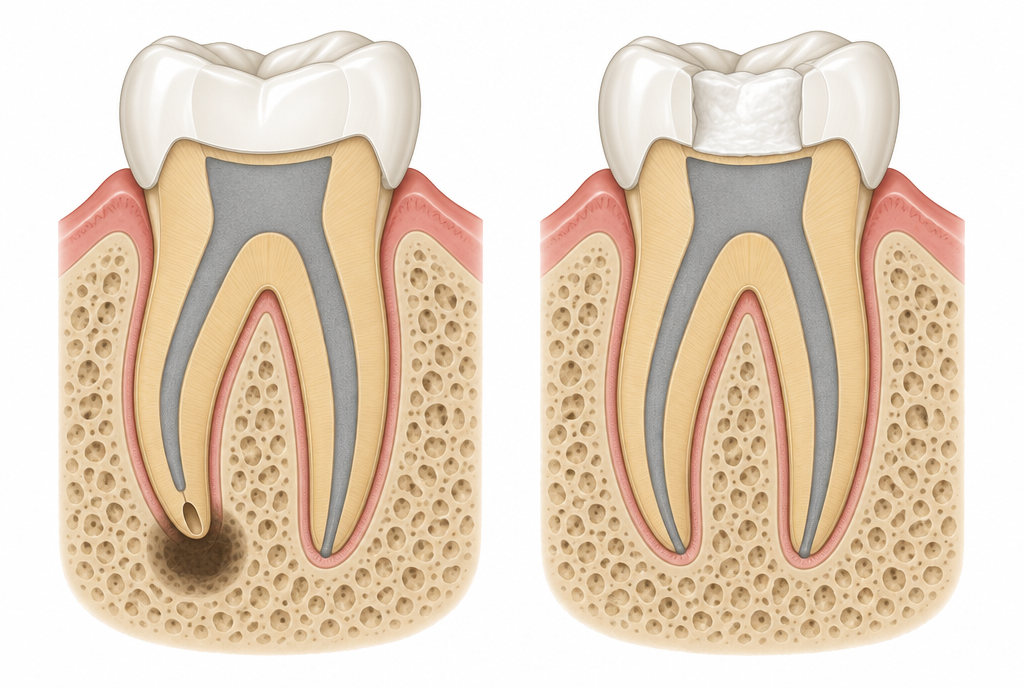
- Examination and an honest assessment. X-rays and a clinical examination locate the source of the infection. The dentist then judges whether retreatment can realistically keep the tooth. If extraction is the more sensible option, you are told before any treatment begins.
- Removing what is in the way. The old root filling is taken out so the canals can be reached again. When necessary, the crown or filling above it comes off first. The AAE adds that a post placed inside the root may also have to be removed.
- Cleaning each canal again. Canals are often fine, curved and branched, which is why infection can persist after a first treatment. Each canal is located, cleaned and disinfected. Depending on how stubborn the infection is, this stage can take more than one visit, with the tooth closed temporarily in between.
- Refilling and sealing. Once the canals are clean, they are filled and sealed again, and, as the AAE describes, the access opening is closed with a temporary filling.
- Planning the final restoration. A retreated tooth may have lost more of its structure. The dentist reviews which final restoration will protect it, often a crown. The choice depends on how much tooth remains.
In general, the AAE describes the cleaning stage of retreatment as done under magnification and illumination, while looking for canals that were missed. Because the old materials have to come out first, retreatment is usually more involved than a first root canal. It also does not always work. The AAE notes that success cannot be promised for any dental procedure and that the options and the chances of success should be discussed before treatment starts.
Retreatment, surgery or extraction: how the choice is made
Three questions usually decide the path.

Can the canals be reached again from the top? A deep post, a canal narrowed by calcium deposits, or a fragment of an instrument left from the first treatment can make re-entry difficult. Intraoral X-rays are the normal starting point. A joint position statement from the AAE and the American Academy of Oral and Maxillofacial Radiology (2015) names small-field cone beam CT (CBCT) as the imaging of choice in retreatment when complications need to be assessed, such as root filling material that extends past the root tip, a separated instrument or a perforation. It also names it for diagnosis when signs and symptoms are unclear or contradictory. Whether your tooth needs a scan is the dentist's decision.
Is the tooth sound enough to keep? If the tooth is badly cracked, decayed deep below the gum, or has lost too much of the bone that supports it, retreatment may not give it a meaningful future. The AAE says a crack that extends below the gum line cannot be treated, and that a fracture running along the root may mean extraction, although surgery is sometimes possible.
Has the problem stayed at the root tip? When inflammation persists in the bone around the end of the root after a root canal, or a canal cannot be cleaned to its end from above, endodontists sometimes treat the root from the side instead. The most common procedure is an apicoectomy, also called root-end resection. The gum next to the tooth is opened, inflamed tissue around the root tip is removed together with the very end of the root, a small filling may seal the end of the canal, and a few stitches close the gum. The AAE describes the bone healing around the root end over a period of months. Surgery can be done together with retreatment or instead of it.
Research has not settled which approach heals better. A Cochrane review (Del Fabbro and colleagues, 2016) found no clear evidence that surgical or non-surgical retreatment led to better healing at one year or later, and rated the evidence as very low quality. In the one trial that measured it, more people reported pain in the first week after surgery. In practice the choice depends on the individual tooth.
Today Dental Clinic's published treatment pages describe root canal retreatment and, where a tooth cannot be kept, extraction followed by a discussion of an implant. Endodontic surgery is described here as general information. If it could apply to your tooth, the dentist will explain whether it is an option and how it would be arranged.
If the tooth cannot be kept, it is removed and the gap is discussed. The usual replacements are an implant, a bridge or a removable partial denture. An implant follows its own staged timeline, with healing time before the final crown.
Situations side by side
This table is a general guide, not a diagnosis. Your own plan comes from the examination.
| Situation | What may be considered | How it can affect the visit plan |
|---|---|---|
| An old root canal hurts again or the gum swells; the tooth is otherwise sound | Retreatment, then a final restoration | Can be a small number of closely spaced visits; a persistent infection may need time between appointments |
| The root canal was done but the final crown was never placed, and symptoms are back | Retreatment, then the protective restoration that was missing | Leave room for both stages, or plan the crown for a later trip with a temporary in place |
| A crown, bridge or post sits on or inside the tooth | Retreatment after the crown or post is removed | A new crown is usually needed, which involves a lab and a separate fitting visit |
| A canal is blocked or very narrow, or inflammation stays at the root tip | Endodontic surgery may be discussed, alone or with retreatment | A separate procedure with stitches; bone healing is checked over months |
| A crack below the gum line, decay deep under the gum, or too little supporting bone | Extraction, then an implant, bridge or partial denture | The replacement has its own timeline, often across more than one trip |
Fitting retreatment into a trip
The clinic's page says retreatment can sometimes be finished during a short visit to Korea, but not always. Straightforward cases may be completed in a small number of closely scheduled visits. A persistent infection may need time between appointments. The final restoration, which may be a crown, can need a separate visit.
A few things make the stay easier to plan:
- Put the examination at the start of the trip. Whether the tooth can be retreated, and how many visits that takes, is only known after the examination and X-rays. Seeing the dentist on day one leaves room to adjust.
- Share your travel dates at the consultation stage. The dentist can then tell you which stages are realistic in the time you have before you commit.
- Expect the crown to be its own step. If a crown or post has to be removed, a new crown means a preparation visit, lab time and a fitting. Some patients finish the retreatment, leave with a well-sealed temporary, and have the crown made on a later trip or closer to home.
- Keep the last day free of treatment if you can. A free day leaves room for a check before you fly, if the dentist suggests one.
After retreatment: the crown and the follow-up X-ray
A retreated tooth needs its final restoration soon. The AAE advises returning to your dentist as soon as possible for a new crown or other restoration once retreatment is complete. The clinic's own page explains why: a delayed or inadequate final restoration can let bacteria back in. This is also one of the reasons the first root canal may have failed.
If you fly home with a temporary in place, ask for a written summary of what was done and what remains. Avoid very hard or sticky food on that side, and set a date for the final restoration rather than leaving it open.
Healing around the root is judged on X-rays over time, not on the day of treatment. Guidance from the European Society of Endodontology recommends reviewing root canal treatment at least one year afterwards, and later if needed. That review can often be done by a dentist near your home. Take copies of your X-rays with you so the later images can be compared with them.
Before you book: what to send and what to ask
The most useful things to send before you travel are:

- Photos of the tooth and the gum around it, taken in daylight.
- Any recent X-rays, and the X-ray from the first root canal if your dentist still has it.
- What you know about the first treatment: roughly when it was done, which tooth, and whether a post or crown was placed.
- When the pain or swelling happens, what sets it off and how long it lasts.
Our article on what to bring from your home dentist explains why older records help even though new X-rays are taken at the clinic.
Questions worth asking at the consultation:
- Does the tooth look worth retreating, or is extraction the more realistic option?
- Will the crown or post have to come off?
- How many visits are likely, and does any stage need time between appointments?
- Which final restoration do you suggest, and can it be done during this trip?
- What should my dentist at home check, and when?
To start, send your photos, any X-rays and your travel dates through our photo consultation. A dentist will tell you what can be seen, what cannot, and what to plan for. You can read more on our root canal retreatment page. Whether a tooth can be retreated, the number of visits and the final restoration are confirmed after the examination and X-rays in the clinic.
Today Dental Clinic (오늘의치과) has three locations: Gangnam Station and Cheongdam in Seoul, and Bucheon. Its team includes a board-certified specialist in conservative dentistry, the field the clinic lists as Conservative Dentistry & Endodontics. Specialists rotate between the three branches, so the branch for your visit is confirmed when the appointment is arranged. This article was written from Today Dental Clinic's published information and the dentists' explanations. It is general information about root canal retreatment, not a diagnosis or a recommendation for any individual.
Questions Patients Ask
Is root canal retreatment the same as a first root canal?→
The aim is the same: clean, disinfect and seal the canals so the tissues around the root can settle. The difference is the starting point. The old root filling has to be removed first, and often the crown or a post above it, before the canals can be cleaned again and checked for any that were missed. That usually makes retreatment more involved than a first root canal.
How many visits does root canal retreatment take?→
It depends on the tooth and the infection. A straightforward case may be finished in a small number of closely scheduled visits. A persistent infection may need time between appointments, with the tooth closed temporarily in between. The final restoration, which may be a crown, can need a separate visit. The dentist can estimate the visits after the examination and X-rays, so share your travel dates at the consultation stage.
Can every failed root canal be redone?→
No. If the tooth is badly cracked, decayed deep below the gum or has lost too much supporting bone, retreatment may not give it a meaningful future. In those cases extraction, followed by a discussion of an implant or another replacement, may be the more realistic path. The dentist explains the options and their limits before you decide.
Do I need a new crown after retreatment?→
Often, yes. If the old crown had to be removed to reach the canals, a new one is usually needed. Even when the crown stays, the tooth needs a well-sealed final restoration soon after retreatment, because a delayed or leaking restoration can let bacteria back in. Which restoration suits the tooth depends on how much structure remains.
What is an apicoectomy, and when is it considered?→
An apicoectomy, or root-end resection, is the most common form of endodontic surgery. The gum beside the tooth is opened, inflamed tissue around the root tip is removed with the very end of the root, a small filling may seal the canal end, and a few stitches close the gum. It may be considered when inflammation persists at the root tip after a root canal, or when a canal is too narrow or blocked to clean from above. This article describes it as general information. If it could apply to your tooth, the dentist will explain whether it is an option and how it would be arranged.
Can a dentist tell from photos whether my old root canal needs redoing?→
Not on their own. Photos can show swelling, a gum boil, a dark tooth or a damaged crown. They cannot show the root filling, the canals or the bone around the root tip. Recent X-rays, the X-ray from the first treatment and a description of your symptoms narrow the picture, but the decision is made after an examination and X-rays in the clinic.
Treatment results, cost and duration may vary by patient. Final treatment plan, cost and duration are confirmed after in-clinic diagnosis.