
The cost depends on what the examination finds, how many teeth and stages are involved, the materials, the lab work and the number of visits. No prices here: ju
What does the cost of dental treatment in Korea depend on? Mostly on five things: what the examination finds, how many teeth and treatment stages the plan involves, which materials are used, how much laboratory work is needed, and how many visits the plan takes. The same named treatment can be a small job or a large one depending on those factors, which is why a figure given before an examination is an estimate rather than a quote.
That is also why this article contains no prices. A number without the conditions behind it tends to mislead more than it helps. What follows is the list of things that actually move the figure, so that when you do get an estimate you can tell what it assumes and what it leaves out.
Why the plan can change after the examination
Photos and a description of your symptoms are enough for a first opinion. They are not enough for a treatment plan. The examination in the clinic usually adds X-rays, and for implants or more complex cases a 3D scan (CBCT), which shows bone volume and the position of nerves and sinuses. It also adds a proper look at your gums, your bite and the teeth you were not asking about.
Three things commonly come out of that examination and change the plan:
- More work than expected. A cavity under an old filling, a cracked tooth, or an infection at a root tip that did not show in a photo.
- Work that has to come first. Gum disease is usually treated before crowns, veneers or implants, because new work placed on unhealthy gums tends not to do well. Active decay is treated before whitening or orthodontics.
- Less work than expected. This happens too. A tooth you assumed needed a crown might be fine with a filling.
If an estimate was given before the examination, ask what it assumed. "One implant, enough bone, no extraction" is a very different plan from "one implant after an extraction and a graft", and the difference only shows up on the scan.
Number of teeth, number of stages
Most dental treatment is charged per tooth, per stage, or both. That makes the count the first thing to understand.
A single crown on a tooth that has already had a root canal is one stage. The same crown on a tooth that still needs a root canal is at least two, and if the tooth also needs a post to hold the core in place, three. An implant is rarely one item either. There may be an extraction, a bone graft, the implant itself, the connecting piece (the abutment) and the crown on top, and each is a separate step that may be listed separately.
The order of work matters as well. When several teeth are involved, a dentist usually plans the whole mouth first and then decides what happens on which trip. Two plans with the same total work can end up quite different in cost if one needs temporary teeth to carry you between stages and the other does not.
When you get an estimate, ask for it broken down by tooth and by stage. A single total for "implant treatment" tells you very little.
Materials and the laboratory
For anything that is made rather than repaired, the material and the way it is made move the figure.
Crowns and bridges can be made from zirconia, glass ceramic, metal with a ceramic layer, or gold alloy. They differ in strength, in how natural they look on a front tooth, and in how much of the tooth has to be reduced. The right choice depends on where the tooth is and how you bite, not only on appearance.
Veneers can be porcelain made in a laboratory or composite resin built up directly on the tooth. They are different treatments with different lifespans and different amounts of preparation.
Implants come from many manufacturers. The implant system, the abutment type (a standard part or one made for you) and the crown material all feed into the cost.
Orthodontics can be done with fixed braces (metal, ceramic, or fitted on the inside of the teeth) or with clear aligners, and the choice affects both the cost and how often you need to be seen.
Laboratory work is part of this. A crown or veneer is designed and made after a scan or impression, and whether the clinic has its own lab, sends work out, or uses a digital workflow changes both the cost and how many days you need to stay. It is fair to ask which material is proposed for each tooth, why, and what an alternative would change.
How treatment stages turn into visits
This is where cost and travel meet. Every stage that needs healing time or laboratory time becomes a separate appointment, and some become a separate trip.
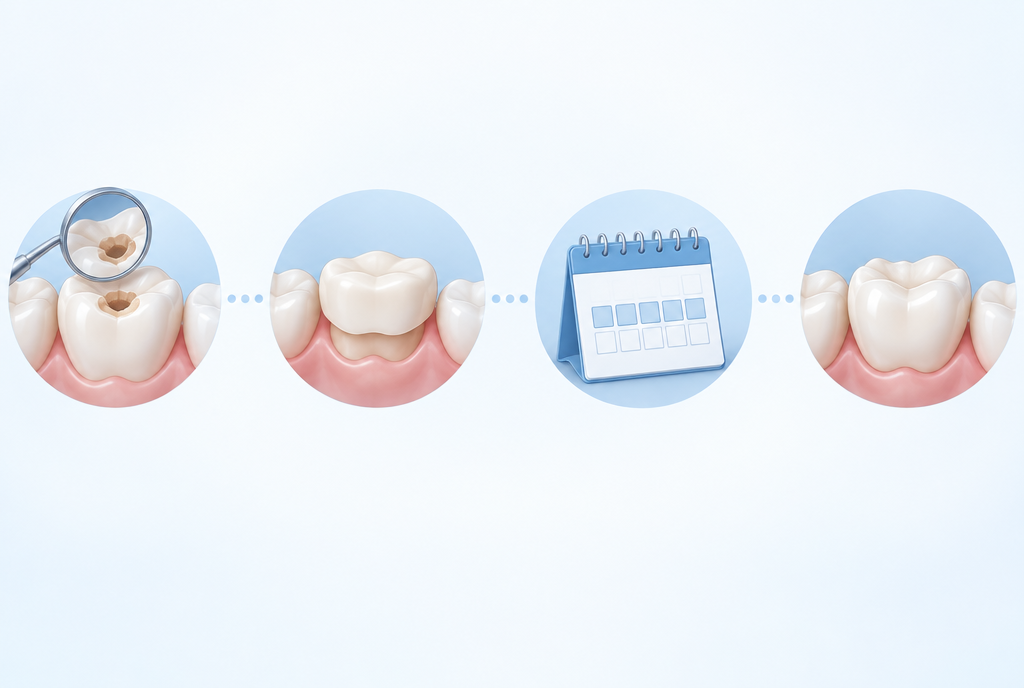
| Stage in the plan | What it usually means for your visit | Why |
|---|---|---|
| Examination and imaging | First appointment, sometimes two | The plan is confirmed only after this |
| Treatment needed first (gums, decay) | Extra appointments at the start | A healthy base before new work |
| Lab-made crowns, veneers, bridges | Several days between scan and fitting | Making and trying in the restoration |
| Implant or bone graft | Usually a second trip months later | Healing that cannot be shortened |
| Orthodontics | Regular check-ins over many months | Teeth move gradually |
A plan that fits in one stay is not automatically cheaper, and a plan that needs two trips is not automatically more expensive in treatment terms. But each trip adds flights, accommodation and time off work to what the treatment really costs you, so it belongs in the conversation from the start. Our guide to how many days to stay in Korea for dental work goes through typical stays by treatment, and how many trips dental implants take explains where the implant healing interval comes from.
Treatment by treatment: what moves the cost
The table below is for preparing questions, not a price list. Each row names the factors that most often change the figure for that treatment, and the question worth asking at your consultation.
| Treatment | What usually changes the cost | What to ask at consultation |
|---|---|---|
| Dental implants | Number of implants, extraction, bone graft or sinus lift, implant system, abutment type, crown material, temporary teeth | Does my scan show that a graft is needed? Which parts, from implant to final crown, does this estimate include? |
| Crowns and bridges | Number of units, root canal or post needed first, material, lab method | Which material for which tooth, and why? Is this tooth ready for a crown now? |
| Veneers (laminates) | Number of teeth, porcelain or composite, amount of preparation, gum contouring, trial mock-up | How many teeth, and do my gums need treatment first? What happens if one chips? |
| Root canal treatment | Which tooth (front or back, number of canals), first treatment or retreatment, crown afterwards | Is this a retreatment? Will the tooth need a crown, and on which trip? |
| Orthodontics and clear aligners | Type of appliance, complexity, length of treatment, number of check-ups, retainers | How will check-ups work while I live abroad? Are retainers and refinements included? |
| Whitening | In-clinic, take-home trays or both, number of sessions, managing sensitivity | I have fillings or crowns on front teeth that will not lighten. Does that need planning? |
| Gum treatment and scaling | Extent of gum disease, number of areas treated, follow-up visits | Does this need to be done before my other treatment, and over how many visits? |
| Wisdom tooth removal | Position (erupted or impacted), how close the roots are to the nerve, stitches and review | Does the 3D scan show the roots near the nerve? When can I fly afterwards? |
Two people who both ask for "four veneers" or "one implant" can end up with plans that look nothing alike. The difference comes from the middle column, and it only becomes visible once someone has examined your teeth.
Things that sit outside the headline figure
Some items are easy to miss because they are not the treatment itself.
- Diagnosis. Whether the examination and 3D scan are included in the estimate or charged separately.
- Temporaries. Temporary crowns or teeth worn between stages, common with implants and with several crowns at once.
- After-care items. Retainers after orthodontics, a night guard after veneers or crowns if you grind your teeth, take-home whitening trays.
- Adjustments and reviews. Whether follow-up checks during your stay are part of the plan.
- Repairs. How the clinic handles a chipped veneer or a loose crown, both while you are in Korea and after you go home.
- Insurance. Short-term visitors are generally not covered by Korea's National Health Insurance, so treatment is billed privately. Cosmetic work such as veneers and whitening is outside insurance coverage for everyone. If you have dental insurance at home, ask your insurer before the trip which documents they need.
- Currency and payment. Estimates are normally given in Korean won. What you pay in your own currency depends on the exchange rate and your card charges on the day you pay, not the day you received the estimate.
Korean law requires medical institutions to make their fees for non-insured items available for patients to see. Asking for the items that apply to you in writing before you agree to treatment is a normal request.
How to get an estimate you can plan around
The more the clinic has to work with, the more useful the answer:
- Clear photos of your teeth from the front and both sides, with your teeth together and apart, plus the biting surfaces if you can manage it.
- Any X-rays or scans from your own dentist, even if they are not recent.
- What bothers you, in your own words, and what you would like to change.
- Your travel dates, or at least how many trips you are willing to make.
With that, a dentist can tell you which factors are likely to apply and give you a provisional plan and estimate. The final plan and cost are confirmed after the examination in the clinic, and if the examination changes something, you should hear why before any treatment starts. To begin, send photos of your teeth through our photo consultation.
Today Dental Clinic (오늘의치과) has three locations: Gangnam Station and Cheongdam in Seoul, and Bucheon. This article was reviewed by the Today Dental Clinic dental team. It is general information about what shapes a treatment plan and its cost, not a diagnosis or an estimate for any individual.
Questions Patients Ask
What does the cost of dental treatment in Korea depend on?→
Mainly on what the examination finds, how many teeth and treatment stages are involved, which materials are used, how much laboratory work is needed, and how many visits the plan takes. The same treatment name can cover a small job or a large one, so any figure given before an examination is a provisional estimate. The plan and cost are confirmed after the examination in the clinic.
Can I get an estimate from photos before I travel?→
Yes, a provisional one. Clear photos of your teeth, any X-rays or scans you already have, a description of what bothers you and your travel dates let a dentist say which factors are likely to apply. It is not a final quote, because X-rays and a 3D scan taken at the clinic can show things a photo cannot, such as decay under old fillings or how much bone is available for an implant.
Why can the plan change after the examination in Korea?→
Because the examination adds information photos do not show. It can find more work (hidden decay, cracks, infection at a root tip), work that has to come first (gum disease before crowns, veneers or implants), or sometimes less work than expected. If anything changes, ask the dentist to explain what was found and how it affects each stage before treatment starts.
Does insurance cover dental treatment in Korea for overseas visitors?→
Short-term visitors are generally not covered by Korea's National Health Insurance, so treatment is billed privately. Cosmetic treatments such as veneers and whitening are outside insurance coverage for everyone. If you have private dental insurance at home, ask your insurer before you travel which documents they need, and ask the clinic for itemised receipts and treatment records you can submit.
Treatment results, cost and duration may vary by patient. Final treatment plan, cost and duration are confirmed after in-clinic diagnosis.