
Flapless implant placement suits healthy, wide-enough bone with firm gum around it, confirmed on a 3D CT scan.
Flapless implant surgery suits people whose jawbone at the implant site is healthy and wide enough, with a band of firm gum around it, and whose 3D CT scan shows the implant can be placed in the planned position without the dentist needing to see the bone directly. When bone is missing or thin, when a graft is needed, or when the gum itself needs reshaping, the gum is usually opened instead. Which of the two fits you is decided by an examination and a 3D CT scan, not by preference, and neither approach is right for every case.
That last point is the one most often lost in search results. "Flapless" describes how the dentist reaches the bone. It does not describe a different kind of implant, and it does not shorten the time the bone needs to grow around the implant. This article explains what the method is, the conditions it depends on, the situations in which a conventional flap is the safer choice, and how the decision is made at the clinic.
What "flapless" means, and what it does not
In conventional implant surgery the dentist makes an incision in the gum and folds it back as a flap, so the jawbone is in full view. The implant is placed, the gum is laid back over or around it, and the incision is stitched.
In flapless surgery the gum is not folded back. The dentist makes a small round opening in the gum, about the width of the implant, directly over the planned site, and places the implant through it. The bone is never exposed to view during the procedure, so its shape and the position of the implant have to be worked out beforehand from the 3D scan. In many cases a surgical guide made from that scan is used to hold the drill at the planned angle and depth.
Three things stay the same whichever approach is used:
- It is still surgery. There is local anaesthetic, a wound in the gum, and a healing period.
- The bone still needs time. The implant has to fuse with the jawbone before the final crown is fitted, and that biological process is not faster because the gum was not opened.
- The later stages are planned separately. Whether you need a second minor procedure to uncover the implant, temporary teeth, or a particular kind of crown is decided on its own merits.
Who flapless placement tends to suit
The method depends on the dentist being able to trust the scan in place of seeing the bone. That is only possible in certain conditions.
- Enough bone in height and width. The implant has to sit fully inside the bone with bone around it on every side. If the ridge is narrow, part of the implant could end up outside the bone, and that cannot be checked by eye through a small opening.
- A healed, even ridge. Bone that has healed evenly after an old extraction is easier to plan on than a ridge with sharp edges, dips or a recent socket.
- Enough firm gum. The pink, firm tissue around teeth (attached or keratinised gum) helps seal the gum around the implant. The punch opening removes a small circle of it. Where that band is already thin, the dentist may prefer to open the gum so it can be moved and kept.
- A safe distance from nerves and the sinus. In the lower jaw a nerve runs through the bone, and above the upper back teeth sits the maxillary sinus. When the scan shows plenty of room, the guided approach can be planned. When the margin is tight, many dentists want direct sight.
- Good general health and no active gum disease. These apply to any implant. Smoking, uncontrolled diabetes and some medications affect healing whichever method is used.
People sometimes ask for flapless placement because they are nervous about surgery. That is understandable, and worth saying at the consultation, but anxiety on its own does not make a case suitable. The bone and gum decide it.
When the gum needs to be opened
A conventional flap is not a fallback for a failed plan. In several common situations it is the approach that lets the dentist do the job properly.
- A bone graft is needed. If the ridge is too thin or too low, bone has to be added, and the graft material has to be placed, shaped and covered. That needs the bone in view. Our article on bone grafting before dental implants explains how the scan shows whether you need one.
- A sinus lift from the side. When the bone between the upper back gum and the floor of the sinus is too short, one way to add bone is through a small window in the side of the jaw, which requires a flap.
- The ridge needs reshaping. Sharp edges or uneven bone may need smoothing before the implant can sit at the right height.
- The gum itself needs work. If there is too little firm gum, the dentist may reposition it or graft gum tissue during the same surgery.
- The scan leaves doubt. If the image does not show the bone shape clearly enough, or the margin to the nerve or sinus is small, opening the gum removes the guesswork.
- Findings during surgery. Sometimes a dentist starts with a small opening and finds the bone is not as the scan suggested. Changing to a flap at that point is a normal, safe decision, and it is worth asking in advance whether that might happen in your case.
Some of these situations are common in people who have been missing a tooth for a long time, because the bone shrinks once the tooth is gone. That is one reason the same request, "one implant", can lead to quite different surgery for two people.
Flapless and conventional flap side by side
The table below is a summary of how the two approaches usually differ. It is not a ranking. Each one has cases where it is the better fit.
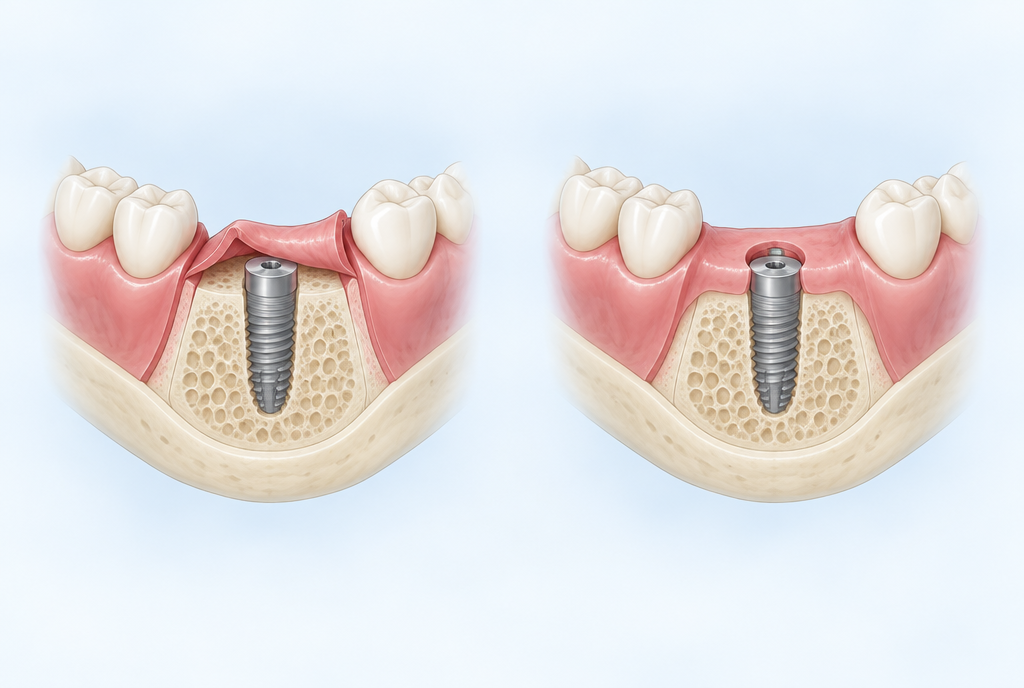
| Flapless (small opening) | Conventional flap (gum opened) | |
|---|---|---|
| How the bone is reached | Small round opening over the planned site; bone is not seen directly | Incision and flap; bone is in full view |
| Bone it needs | Healthy bone with enough height and width all around the implant, confirmed on 3D CT | Can be used across a wider range of bone conditions |
| Gum it needs | Enough firm gum around the site; the opening removes a small circle of it | Gum can be moved, kept or grafted during surgery |
| Bone graft at the same time | Generally not suited to grafts that need shaping and covering | Possible; the graft can be placed and covered under direct view |
| Stitches | Often few or none, depending on the case | Usually needed |
| First days of recovery | Trials report less discomfort on average, though it varies; it is still surgery | Swelling and tenderness for the first few days are common; this varies from person to person |
| Main limitation | Relies on the accuracy of the scan and plan; the dentist cannot see the bone | Larger wound and stitches to heal |
| Healing before the final crown | Bone integration and gum healing are checked first | Bone integration and gum healing are checked first |
The last row is the same on both sides on purpose. The timing of the final tooth depends on the bone and on stability measurements, not on how the gum was opened.
How the 3D CT scan decides: the steps in order
At Today Dental Clinic the choice of method is made after the oral examination and a 3D CT scan. In practice the steps run like this.
- Before you travel. Photos of the area, any X-rays or scans from your own dentist, your medical history and your travel dates. This gives a first opinion on whether an implant is likely to be straightforward or likely to need extra stages. It cannot decide the surgical method.
- Oral examination. The dentist checks the gums around the site, the thickness of firm gum, your bite, and the teeth next to the gap. Any active gum disease or decay is planned for first.
- 3D CT (CBCT) scan. This shows the height, width and density of the bone, and the position of the nerve and the sinus. It is the step that decides whether there is enough bone all around the planned implant.
- Digital planning. The implant position, angle and depth are planned on the scan. For a flapless case, a surgical guide may be prepared from this plan.
- The decision. Flapless placement, placement with a conventional flap, or a bone graft first and the implant later. The dentist should be able to show you on the scan why.
- Surgery, with a fallback agreed in advance. If the bone turns out to be different from the image, the method can change during the procedure.
- Healing and stability check. Before the crown is connected, the dentist checks gum healing and how firmly the implant is held in the bone. Stability readings (ISQ) are one part of that check.
If someone recommends flapless surgery before any scan has been taken, ask what that recommendation is based on.
What studies say about recovery and results
Research comparing the two approaches is useful, but it answers fewer questions than people often expect. A systematic review in Periodontology 2000 (Romandini and colleagues, 2022) looked at randomised trials of flapless, fully guided placement against conventional flapped surgery. Patients in the flapless groups reported less pain after surgery on average and the operations were shorter, but the certainty of the pain finding was rated low, intraoperative complications did occur, and in some cases the implant could not be placed with the flapless protocol. The authors noted that evidence on long-term results was still limited and stressed careful case selection.
Earlier reviews comparing implant survival, bone levels around the implant and complication rates (for example Lemos and colleagues, 2020) found no significant difference between the two approaches over the follow-up periods studied. Another review (Chrcanovic and colleagues, 2014) found a difference in failure rates but cautioned that the result changed depending on which studies were included.
For a patient, the reasonable reading is this: in suitable cases flapless placement may mean an easier first few days, while the long-term outcome depends mostly on bone, gum health, planning and care, not on the opening method. It is a good option where it fits, not a reason to force a case into it.
Planning your trip around it
Choosing flapless placement does not remove the healing interval between placing an implant and fitting the final crown. In most plans that interval means a second trip to Korea, and the exact timing is set by how the bone heals. Our guide to how many trips dental implants take explains where that interval comes from and how the visits are usually grouped.
What flapless placement can change is how you feel in the days right after surgery, which may matter if you plan to sightsee or fly home soon after. Ask at the consultation when you can fly, what you can eat, and which follow-up check has to happen before you leave.
A useful set of questions to bring:
- Does my scan show enough bone all around the implant for flapless placement?
- Is the firm gum around the site thick enough, or would you want to open it?
- If a graft is needed, will it be done at the same time or as a separate stage?
- What happens if the bone looks different during surgery?
- When will the crown be fitted, and does that mean a second trip?
To start, send photos of the area and any X-rays you have through our photo consultation. A dentist can tell you which questions above are likely to apply before you book flights. The method, the stages and the timing are confirmed after the examination and 3D CT in the clinic.
Today Dental Clinic (오늘의치과) has three locations: Gangnam Station and Cheongdam in Seoul, and Bucheon. This article was reviewed by the Today Dental Clinic dental team. It is general information about how implant surgery is planned, not a diagnosis or a recommendation for any individual.
Questions Patients Ask
Is flapless implant surgery suitable for everyone?→
No. It needs healthy jawbone with enough height and width all around the planned implant, enough firm gum at the site, and a safe distance from the nerve or sinus, all confirmed on a 3D CT scan. When bone is thin or low, when a graft is needed, or when the gum itself needs work, the gum is usually opened instead. The method is decided after the examination and scan in the clinic.
Is flapless implant surgery less painful than conventional implant surgery?→
Randomised trials summarised in a 2022 systematic review found that patients reported less pain after flapless guided placement on average, but the certainty of that finding was rated low and experiences vary. It is still surgery under local anaesthetic, with a small wound that has to heal. Long-term results in reviews have looked broadly similar between the two approaches in suitable cases.
Can a flapless implant be finished in one trip to Seoul?→
Usually not. Flapless placement changes how the bone is reached, not how long the bone takes to fuse with the implant. In most plans the final crown is fitted after a healing interval, which means a second trip. The timing is set after the dentist checks healing and implant stability.
What happens if the dentist finds I need a bone graft or the bone looks different during surgery?→
If the scan shows a graft is needed, the gum is normally opened so the graft can be placed and covered, either at the same time as the implant or as an earlier stage. If the bone looks different from the scan during a flapless procedure, the dentist can change to a conventional flap. Ask at your consultation whether that could apply to you.
Treatment results, cost and duration may vary by patient. Final treatment plan, cost and duration are confirmed after in-clinic diagnosis.