
Many implant patients need no bone graft, but bone loss after extraction, a thin ridge or a low sinus in the upper back jaw can call for one.
Not everyone needs a bone graft before dental implants. A graft is considered when the jawbone at the planned site is too thin, too short or too close to the sinus to hold an implant in the position the crown needs. That is common after a tooth has been missing for some time, after gum disease, and in the upper back jaw, where the sinus sits just above the roots. Whether you need one, and which kind, is decided after an in-person examination and a 3D CT (CBCT) scan. Photos alone cannot show it.
For an overseas patient, the answer matters for the calendar as much as for the surgery. A small graft placed together with the implant may leave the trip plan close to that of a standard implant. A graft that has to heal before the implant goes in usually adds a stage. Bone grafts and sinus lifts also bring their own rules about flying. This article explains why bone goes missing, the main types of grafting in plain terms, how the decision is made, and how each option can change the number of visits and the gap between them.
Why the bone is sometimes not there
An implant has to sit fully inside bone, with bone around it on every side. When there is not enough, the implant either cannot be placed where the crown needs it or would be poorly supported.
The most common reason is the extraction itself. Once a tooth is removed, the bone that held it remodels and shrinks. A systematic review of human studies (Tan and colleagues, 2012) reported horizontal bone loss of 29 to 63% and vertical loss of 11 to 22% within about six months of extraction in re-entry studies, with the fastest change in the first months. Width is usually lost more than height. That is why a ridge that looked fine on the day the tooth came out can be narrow a year later.
Other reasons come up often:
- Gum disease. Periodontitis breaks down the bone around teeth. By the time a tooth is lost, part of its bone may already be gone.
- The sinus in the upper back jaw. The maxillary sinus is an air space above the upper premolars and molars. After those teeth are lost, the bone below the sinus can become shorter from both sides: the ridge shrinks from below, and the sinus floor can extend downward. A 2025 meta-analysis found that preserving the socket at extraction in this area reduced that downward expansion, though it was based on a small number of studies.
- Years of denture wear, or an old bridge or implant that failed. Pressure from a denture, or infection around an old restoration, can change the ridge over time.
The main types of bone grafting, in plain terms
"Bone graft" covers several procedures. They share one idea: material is placed where bone is missing, and new bone gradually forms in and around it. They differ in where they are done and when.
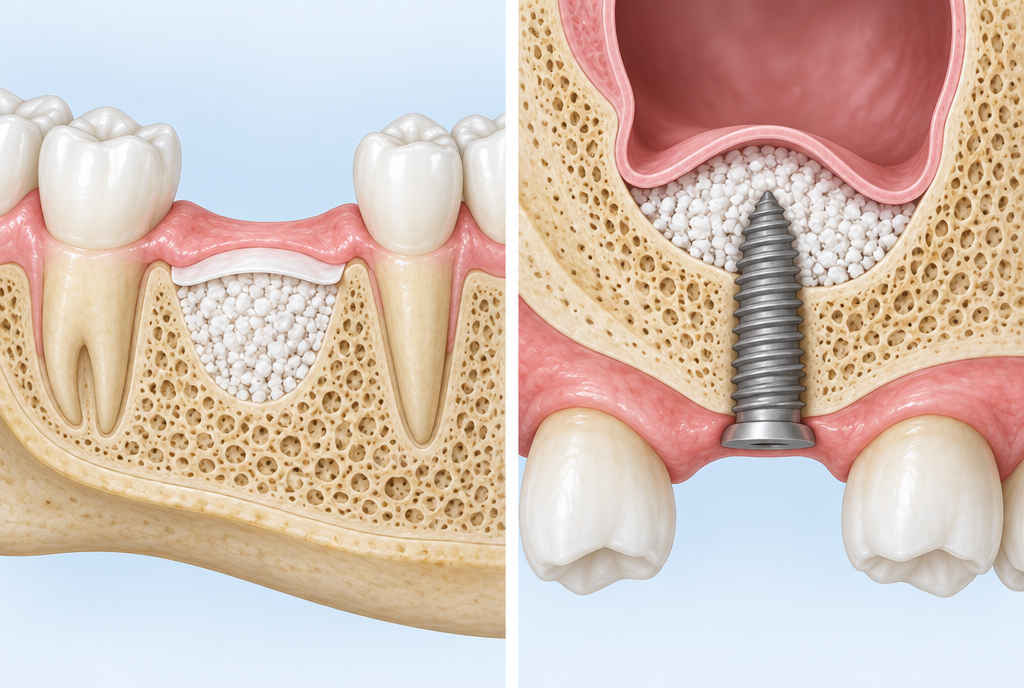
Socket preservation (ridge preservation). This is done at the time of extraction. Graft material is placed in the empty socket and covered, to limit the shrinkage described above. A Cochrane review (Atieh and colleagues, 2021) concluded that it may reduce the loss of ridge height and width at six months, rated the evidence as very uncertain, and found no clinically meaningful difference between grafting materials. It does not stop all change. The implant goes in later, once the socket has healed.
Guided bone regeneration, or ridge augmentation. This is used when a healed ridge is too narrow or too low. Graft material is placed against the bone and covered with a membrane that keeps gum tissue out of the space while bone grows in. When the defect is small and the implant can still be held firmly, this can happen in the same surgery as the implant. When the defect is larger, the ridge is usually rebuilt first and the implant placed in a later stage.
Sinus lift (sinus floor elevation). This is used in the upper back jaw when the bone below the sinus is too short. The sinus is lined with a thin membrane. The surgeon lifts that membrane away from the sinus floor and places graft material in the space underneath, so the implant has more bone height to sit in. There are two main routes:
- Crestal approach. The sinus floor is reached from below, through the opening prepared for the implant. The membrane is raised a short distance, graft material may be added, and the implant is often placed in the same visit. It tends to be used when a moderate amount of bone height remains.
- Lateral approach. A small window is made in the side wall of the upper jaw, through the gum above the back teeth. This gives direct access to lift the membrane further and place more graft material. It tends to be used when very little bone remains. The implant may go in at the same time if the remaining bone can hold it steady, or later.
A 2023 meta-analysis comparing the two routes in sites with 6 mm of bone or less found no significant difference in implant survival or in how often the sinus membrane was torn, although the included studies carried a high risk of bias. Which route suits a given site is decided from the scan.
Graft materials. Material can come from your own body (autogenous bone), from a human donor (allograft), from an animal source (xenograft), or be synthetic. At Today Dental Clinic the dentist chooses among these after assessing the size and location of the defect and the bone quality on 3D CT. In suitable cases, material processed from your own extracted tooth may be considered. The proposed material is discussed with you before treatment.
How the decision is made
A graft cannot be planned from a panoramic X-ray or a photo. A panoramic image is flat. It can suggest that bone height is low, but it cannot show the width of the ridge or the shape of the sinus floor. The American Academy of Oral and Maxillofacial Radiology recommends cross-sectional imaging for implant sites and names CBCT as the method of choice.
At Today Dental Clinic in Seoul, a graft or ridge augmentation is planned after the in-person examination and a 3D CT scan, which together show:
- Bone height, width and density across the site.
- Where the sinus floor, or the nerve in the lower jaw, sits relative to the planned implant.
- Where bone has to be rebuilt, and how much.
- Which graft material suits the defect.
- Whether the graft and the implant can share one surgery or need separate stages.
- Gum health, medical history, medications and smoking, all of which affect healing.
Point five changes travel plans the most. It usually comes down to whether the implant can be held firmly in the bone that is already there. If it can, a graft can often be placed around it at the same time. If not, the bone has to be rebuilt and allowed to mature first.
Later stages are reviewed, not fixed in advance. A graft can need more healing time than planned, and an implant can fail to integrate. Before the crown is connected, the clinic checks healing and measures how firmly the implant is held in the bone (an ISQ reading), rather than working to a set date.
Situations side by side
This table is a general guide, not a diagnosis. Your own plan comes from the examination and scan.
| Situation | What may be considered | How it can affect the visit plan |
|---|---|---|
| A tooth needs to come out and an implant is planned later | Socket preservation at the time of extraction | Extraction fits into one trip; the implant follows after the socket heals, often on a later trip |
| Healed ridge, slightly narrow, implant can still be held firmly | Guided bone regeneration in the same surgery as the implant | Often no separate trip for the graft; healing is checked before the crown; the bone-graft flying caution applies |
| Ridge too thin or too low to hold an implant | Ridge augmentation first, implant in a later stage | Adds a stage (graft, then implant, then crown) with months of healing in between; flying is restricted for a period after the graft |
| Upper back jaw, some bone left below the sinus | Crestal sinus lift, often with the implant in the same visit | Visit structure can stay close to a standard implant; sinus precautions apply before flying |
| Upper back jaw, very little bone left below the sinus | Lateral sinus lift, implant at the same time or later | May add a stage; flying is restricted for a period after surgery |
| Bone lost to gum disease or around an old implant | Treating the infection first, then grafting where needed | Gum treatment may come before any graft or implant |
How grafting can change an overseas trip
For a straightforward implant, the usual pattern is one trip to examine and place the implant and a second trip for the final crown after integration. Our guide to how many trips dental implants take explains that pattern and where the healing interval comes from. Grafting can change it in two ways: by adding a stage, and by lengthening the gap.
When the graft is placed together with the implant, the number of trips often stays the same, although the wait before you can fly home may be longer than after an implant alone. The healing period before the crown still depends on how the bone responds, and it is checked before the crown is connected.
When the graft is staged, the bone has to mature before the implant goes in. For sinus augmentation, patient information from the American Academy of Periodontology describes bone usually being left to develop for about four to 12 months before implants are placed, depending on the person. Ridge augmentation also heals over months rather than weeks. The usual integration period for the implant comes after that. A staged plan can mean an extra trip, or two trips spaced further apart. Your dentist confirms the interval after the examination and reviews it again as healing progresses.
Some practical points:
- Send what you have before you fly. Recent X-rays or a CT scan from your own dentist give the clinic an early idea of whether a graft is likely. It is a first read only; the plan is set after the 3D CT in Korea.
- Put surgery early in your stay. Swelling is common in the first days after surgery, and a check before you leave is worth having.
- Ask what can be checked near home. Some routine checks during healing can be done by a local dentist and shared with the clinic. Take copies of your scans and surgical notes with you.
- Book the return flight after the plan. The number of days in Korea is confirmed after diagnosis.
Flying and the first weeks after a graft
After a straightforward implant, the wait before flying is short. A bone graft or a sinus lift changes that. Cabin pressure changes during a flight affect the sinuses, and pressure in a healing sinus can disturb the graft. Published guidance gives ranges rather than one rule:
- McGill University's oral and maxillofacial surgery service advises avoiding air travel for at least two weeks after a sinus lift, and avoiding blowing your nose for at least a week. If you need to sneeze, sneeze with your mouth open.
- A 2023 paper on dental tourism in the British Dental Journal suggests waiting at least 72 hours after uncomplicated implant placement before flying. It puts sinus lifts and dental bone grafts in the same group of more involved procedures, with at least two weeks before flying, provided there is no pain, swelling or bleeding at the site. For a sinus lift it gives six weeks as the recommended interval, and advises making sure there are no sinus symptoms before flying.
Other surgeons use different intervals. The one that applies to you is the one your own dentist gives, based on what was done. Our article on when you can fly after dental treatment covers the general reasoning about cabin pressure, swelling and timing.
In the first days after any graft, some swelling and tenderness is common, and mild bleeding is expected in the first 24 hours. Soft food, no smoking and no alcohol help the site settle. Contact the clinic if bleeding does not settle. Stitches, if any, are checked before you fly.
Questions to ask before you book
- Do my X-rays suggest that a graft may be needed, and which kind?
- Can the graft be done in the same surgery as the implant, or will it be a separate stage?
- If it is staged, roughly how long is the healing before the implant, and how will that be confirmed?
- Which graft material do you propose, and why?
- If I need a graft or a sinus lift, when can I fly, and what should I avoid until then?
- Which checks can a dentist near my home do?
To start, send photos of the area and any X-rays or scans you have through our photo consultation, together with your travel dates. A dentist can tell you whether a graft looks likely and which of the questions above apply to you. Whether a graft is needed, the type, the number of visits and the timing are confirmed after an examination and 3D CT in the clinic.
Today Dental Clinic (오늘의치과) has three locations: Gangnam Station and Cheongdam in Seoul, and Bucheon. This article was written from Today Dental Clinic's published information and the dentists' explanations. It is general information about bone grafting before implants, not a diagnosis or a recommendation for any individual.
Questions Patients Ask
Can a bone graft be done on the same day as the dental implant?→
Sometimes. When the implant can be held firmly in the bone that is already there, a graft can often be placed around it in the same surgery, and a crestal sinus lift is often done in the same visit as the implant. When the ridge is too thin or too short, or a larger sinus graft is needed, the bone is usually rebuilt first and the implant placed in a later stage. This is decided after an examination and a 3D CT scan.
Does a bone graft hurt?→
The procedure is done under local anaesthetic, so the area is numbed during surgery. Afterwards, some swelling and tenderness is common for the first days, and mild bleeding is expected in the first 24 hours. How much you feel varies from person to person and with the size of the graft. The clinic gives aftercare instructions and asks you to get in touch if bleeding does not settle.
Can I fly after a sinus lift?→
Not straight away. McGill University's oral and maxillofacial surgery service advises avoiding air travel for at least two weeks after a sinus lift, and a 2023 British Dental Journal paper gives two weeks as a minimum and six weeks as the recommended interval, once there are no sinus symptoms. The same paper puts bone grafts in the two-week group too, provided there is no pain, swelling or bleeding at the site. Avoid blowing your nose and sneeze with your mouth open while it heals. Your own dentist gives the date that applies to you.
How can I tell before travelling whether I need a bone graft?→
Recent X-rays, a CT scan from your own dentist and photos of the area give an early indication, so it is worth sending them before you book. A flat panoramic X-ray cannot show the width of the ridge or the exact shape of the sinus floor, so the decision is made after the in-person examination and 3D CT scan in Korea.
How long after a bone graft can the implant be placed?→
If the graft is placed with the implant, there is no separate wait. If it is staged, the bone needs months to mature first. For sinus augmentation, American Academy of Periodontology patient information describes about four to 12 months, depending on the person. Your dentist confirms the interval after the examination and reviews it as healing progresses.
Treatment results, cost and duration may vary by patient. Final treatment plan, cost and duration are confirmed after in-clinic diagnosis.